
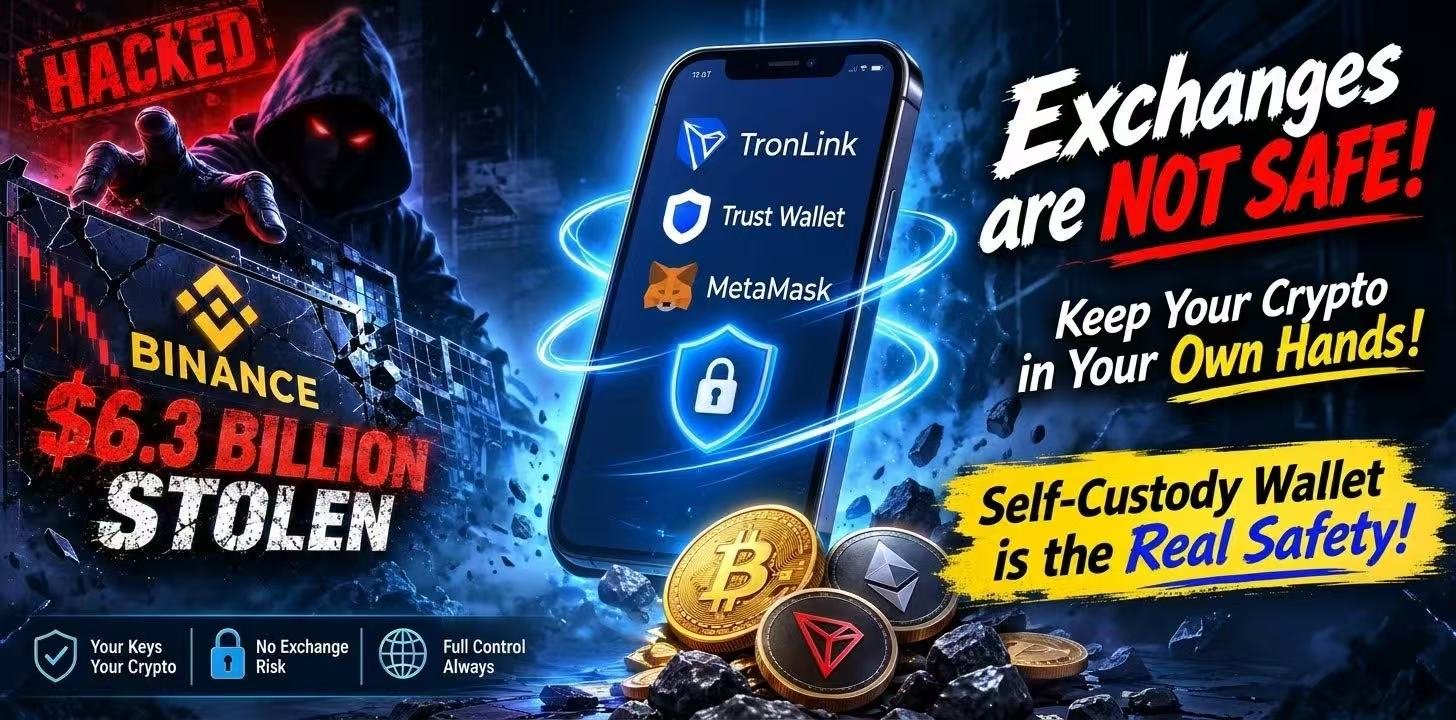
If you also hold cryptocurrency on centralized exchanges, please take 5 minutes to read this article carefully.
On the early morning of October 30, 2026, the crypto industry faced a security incident that could go down in history.
Binance, one of the world’s largest cryptocurrency exchanges, was reportedly attacked, affecting approximately $6.3 billion worth of BTC, ETH, BNB, USDT, USDC, and other digital assets.
When the news broke, many investors had the same question: “If a platform as large as Binance can be hit, where should I keep my assets?”
More concerningly, this was not an isolated incident.
On February 21, 2025, another major exchange, Bybit, suffered a shocking attack in which approximately $1.5 billion worth of ETH-related assets was stolen. At the time, it was considered the largest single theft in the history of the crypto industry. The FBI later attributed the attack to TraderTraitor actors linked to North Korea.
Just over a year later, the Binance incident pushed the industry’s security record to an even more alarming level.
From Bybit’s $1.5 billion loss to Binance’s $6.3 billion incident, both events carry the same warning: even the largest exchanges are not immune to security breaches.
If all your long-term assets are still on an exchange, what you may have is just a number displayed in an account—not unrestricted control over your assets.
Do the Coins on an Exchange Really Belong to You?
Many people log in to an exchange, see a BTC, ETH, or USDT balance, and assume their assets are safely theirs.
But on most centralized exchanges, the exchange controls the private keys and the blockchain addresses. Users hold an account on the platform and the right to request deposits, trades, and withdrawals under the platform’s rules.
In other words, as long as your coins remain on an exchange, you are relying on the exchange to ensure that:
It will not be attacked again;
Its asset management systems will not be compromised;
Employees will not act improperly;
Customer assets will not be misused;
It will have enough assets to meet a wave of withdrawal requests;
Withdrawals will not suddenly be suspended;
Your account will not be frozen because of risk controls or identity checks;
It will still be able to compensate users if a major loss occurs.
Large exchanges typically have security teams, multi-step approval processes, reserve disclosures, and risk funds. But the Bybit and Binance incidents show that larger pools of funds can attract increasingly sophisticated attackers.
Large exchanges concentrate the assets of millions of users, making them valuable targets for hackers and professional threat actors.
A platform’s size does not mean it can never be breached.
What the $1.5 Billion and $6.3 Billion Incidents Teach Everyday Users
On February 21, 2025, Bybit was hit by a sophisticated attack during an asset transfer. Approximately $1.5 billion in digital assets was moved to addresses controlled by the attackers.
The FBI later confirmed that TraderTraitor actors linked to North Korea were responsible. After the theft, the attackers quickly converted the assets and spread the funds across a large number of addresses on different blockchains.
In October 2026, similar risks surfaced on an even larger scale when approximately $6.3 billion in Binance assets were affected. The incident renewed concerns about the systemic risks associated with centralized custody.
These events do not mean that every exchange will collapse, nor that users will necessarily be unable to recover their assets. Large platforms may use risk funds, insurance arrangements, or company funds to cover losses.
But investors should ask themselves one question:
What happens if the next platform that gets hit does not have enough money to compensate its users?
When all your assets are concentrated on an exchange, your ability to withdraw them depends not only on the blockchain, but also on the platform’s security, reserves, financial condition, and response.
That is the risk of exchange custody.
Why Might a Self-Custody Hot Wallet Be Safer Than an Exchange?
A self-custody hot wallet is a software wallet that stays connected to the internet but lets users control their own private keys or recovery phrases.
The most important difference between a hot wallet and an exchange account is not the app’s design or the number of tokens it supports. It is this:
Who ultimately controls the assets?
With a genuine self-custody hot wallet, users hold their own private keys or recovery phrases. The wallet developer, an exchange, or another third party generally cannot directly transfer or freeze the user’s on-chain assets.
That does not mean a hot wallet can never have problems. It means users do not have to place all their trust in a single centralized platform.
1. Reduce the Risk of a Single Exchange Failure
When millions of users keep their assets on the same exchange, it creates a high-value target worth tens or even hundreds of billions of dollars.
If the exchange’s security systems, approval processes, or asset management operations are compromised, a large number of users may be affected at once.
With self-custody hot wallets, assets are spread across blockchain addresses controlled by different users. If an exchange suspends withdrawals, suffers an attack, or runs into business problems, assets in a user’s personal wallet do not automatically disappear.
2. Take Back Control of Your Assets
With a self-custody hot wallet, users control their assets through their private keys or recovery phrases. They can initiate on-chain transfers without first submitting a withdrawal request to an exchange.
As long as the blockchain is operating normally, users can transfer their assets according to their own decisions.
This is the idea behind a well-known phrase in crypto:
“Not your keys, not your coins.”
If you do not control the private keys, you do not have full control over the coins.
3. Reduce the Impact of Suspended Withdrawals and Frozen Accounts
An exchange may suspend withdrawals for a particular network because of system maintenance, congestion, security reviews, liquidity pressure, or regulatory requirements.
Accounts may also be temporarily restricted because of login changes, identity verification, risk reviews, or regional limitations.
Assets in a self-custody hot wallet generally do not depend on a single exchange’s withdrawal system. Users can receive or transfer assets directly on-chain, or connect to compatible wallet applications.
4. Organize Your Assets into Separate Wallets
Users can create multiple self-custody hot wallets for different purposes, such as:
A long-term storage wallet;
A wallet for everyday transfers;
A DeFi interaction wallet;
An NFT wallet;
A TRON and USDT receiving wallet.
Wallets used for different purposes should not share the same recovery phrase.
This way, even if an interaction wallet that is frequently connected to websites is exposed to a malicious approval, assets in other independent wallets may not be affected.
Compared with keeping everything in one exchange account, using separate wallets can help limit the impact of a single security incident.
5. Verify Assets Directly on the Blockchain
Balances and transaction histories in a self-custody hot wallet can be checked using a blockchain explorer.
Users do not have to rely entirely on an exchange’s internal balance display to verify whether assets are held at their own addresses.
However, blockchain addresses and their transaction histories are generally public. Avoid posting the addresses that hold your main assets on social media, and do not concentrate all your funds in one publicly known receiving address.
A Hot Wallet Is Not a Safe: A Mistake Can Still Cost You Everything
One point must be made clear:
Self-custody hot wallets reduce exchange custody risk; they do not eliminate every security risk.
When you move coins to a personal wallet, control of the assets returns to you—and so does the responsibility for securing them.
Self-custody hot wallets may still be exposed to risks such as:
Malware on a phone or computer;
Fake wallet apps;
Leaked recovery phrases or private keys;
Phishing links and spoofed websites;
Malicious DApps;
Signing transactions you do not understand;
Granting excessive permissions to a malicious contract;
A malware-altered address being pasted into a transaction;
Selecting the wrong blockchain network;
Sending assets to an address that does not support them;
Losing your recovery phrase and all recovery records.
If you lose the password to an exchange account, you may be able to recover it through identity verification. If you permanently lose the recovery phrase for a self-custody wallet, there is usually no customer support team that can restore access.
A more accurate conclusion is:
Used correctly, a self-custody hot wallet can reduce your exposure to centralized exchange risks. Poor management of private keys and permissions, however, can also lead to irreversible losses.
If Your Assets Are Still on an Exchange, Here’s How to Move Them Gradually
Do not rush into transferring assets out of fear after seeing the Binance and Bybit incidents.
Blockchain transfers are generally irreversible. Entering the wrong address, choosing the wrong network, or downloading a fake wallet can result in permanent losses.
You can move your assets gradually by following these steps:
Download the wallet from its official website or a verified official app-store listing. Carefully check the URL, developer name, and download source.
First, withdraw a small test amount from the exchange—an amount you can afford to lose.
Before withdrawing, carefully check that the coin, receiving address, and blockchain network all match. For example, USDT is available on TRON, Ethereum, and other networks. Choosing the wrong network may prevent your assets from arriving correctly.
Wait for the test transfer to be confirmed on-chain. Once you have verified that the wallet displays the assets correctly and can send them, move the remaining funds in batches.
Use separate wallets for long-term storage, everyday transfers, and on-chain interactions. Avoid using one wallet for everything.
Regularly review wallet permissions and revoke smart contract permissions that you no longer use or do not recognize.
Do not transfer all your assets at once the first time. Even if an address looks correct, complete a small test transfer first.
Which Self-Custody Hot Wallets Are Worth Learning About?
The wallets below are included to explain their different use cases. This does not mean that any wallet is absolutely secure, and it is not investment advice.
Before downloading any wallet, independently verify its official website.
MetaMask
MetaMask is one of the more widely used self-custody hot wallets, primarily for Ethereum and EVM-compatible networks.
It offers browser extension and mobile app versions and is compatible with many DeFi, NFT, and on-chain applications. It may suit users who regularly use Ethereum, BNB Smart Chain, Polygon, Arbitrum, and other EVM networks.
Because MetaMask is often used to connect to websites, users should be especially alert to phishing pages, malicious signatures, and unlimited token approvals.
It is a good idea to keep a wallet used for everyday interactions separate from the wallet holding your main assets.
Trust Wallet
Trust Wallet is a multi-chain self-custody hot wallet with mobile and browser extension versions. It can be used to manage assets across a range of blockchains.
It may suit users who want to view assets from multiple networks in one app.
Multi-chain support is convenient, but users must distinguish between networks carefully. When transferring USDT, make sure the withdrawal network selected on the exchange exactly matches the receiving network supported by the wallet.
TronLink
TronLink is a commonly used self-custody hot wallet in the TRON ecosystem, available as a mobile app and browser extension.
It may be a good fit for users who frequently receive or transfer USDT on the TRON network. TRON’s official developer documentation also describes TronLink as a widely used wallet in the TRON community.
When using TronLink to transfer assets, pay attention to your TRX balance, network resources, and transaction fees. Unknown tokens appearing in your wallet, airdrop links, and supposed upgrade campaigns may be scam bait.
Do not connect to unfamiliar websites or sign transactions just to claim rewards from unknown sources.
Rabby Wallet
Rabby Wallet is a self-custody hot wallet for the EVM ecosystem. It may suit users who regularly use multiple EVM networks and DeFi protocols.
It offers features such as transaction simulations, risk warnings, and permission displays, which can help users understand the possible asset changes before signing a transaction.
However, transaction simulations and risk alerts are only aids. No security feature can replace checking the website, contract, and transaction details yourself.
Coinbase Wallet
Coinbase Wallet is a self-custody wallet. It is not the same product as a Coinbase exchange account.
When using the self-custody version, users are responsible for managing their own recovery information. A wallet’s association with a well-known exchange does not mean that the platform can restore assets if a user loses their private keys.
When choosing a product, make sure you know whether you are using an exchange account or a self-custody wallet in which you control the private keys.
TokenPocket
TokenPocket is a reputable decentralized multi-chain self-custody hot wallet with comprehensive mobile, browser extension, and hardware wallet support. It accommodates hundreds of mainstream blockchains, covering BTC, ETH, BNB Smart Chain, TRON, Polygon, and all EVM-compatible networks, delivering unified multi-chain asset management for global users.
All private keys and recovery data are locally generated and stored on user devices, ensuring exclusive user ownership of on-chain assets without third-party custody or access. Featuring built-in DApp integration, secure cross-chain transfers, and practical asset management tools, it suits both daily asset storage and routine on-chain interactions.
Users must still verify official download channels and manage wallet permissions properly to avoid phishing risks and unauthorized asset exposure.
How to Choose a Hot Wallet That Fits Your Needs
Different wallets support different blockchains and use cases. No single wallet is right for everyone.
You can start by considering which networks you use most:
For Ethereum and EVM networks: consider MetaMask or Rabby Wallet;
To manage assets across multiple networks in one app: consider Trust Wallet or TokenPocket;
For USDT on the TRON network: consider TronLink;
For a multi-chain self-custody product from a well-known brand: consider Coinbase Wallet.
Whichever wallet you choose, follow these basic principles:
Download only from verified official sources;
Never share your private keys or recovery phrase with anyone;
Do not trust unsolicited messages from supposed wallet support staff;
Do not enter recovery information on unfamiliar websites;
Check the address, asset, and blockchain network before transferring;
Start with a small test transfer, then move assets in batches;
Regularly review and revoke unnecessary contract permissions.
Do You Need to Trade Your Coins, or Hold Them for the Long Term?
An exchange is not inherently unusable.
Centralized exchanges remain convenient for users who trade frequently, convert assets, or use fiat on- and off-ramps.
The real problem is treating an exchange as the long-term home for all your assets.
A more considered approach is:
Keep funds needed for near-term trades on a trusted exchange;
Use a separate self-custody hot wallet for everyday transfers;
Keep long-term holdings in another self-custody hot wallet that is not connected to unfamiliar websites;
Use a separate wallet with a small balance for DeFi and NFT activity;
Avoid concentrating all your assets on one platform or in one wallet.
Security is not about moving from one extreme to another. It is about spreading risk, separating uses, and retaining control of your main assets.
Conclusion: Have You Taken Back Control Before the Next Attack?
From the approximately $1.5 billion stolen from Bybit in 2025 to the approximately $6.3 billion in assets affected in the Binance incident in 2026, the scale of security incidents has become increasingly alarming.
Large exchanges have professional security teams, but attackers are also becoming more sophisticated.
If all your long-term assets are still on an exchange, they remain exposed to the risks of a platform attack, account freezes, suspended withdrawals, liquidity problems, or business failure.
Moving assets to a self-custody hot wallet does not make risk disappear.
What it does is return control of the assets from a centralized platform to you.
It also means that you must take the security of your private keys, recovery information, wallet permissions, and devices seriously.
An exchange can be useful for trading, but it should not be the only place where you keep your assets.
Do not wait for the next multibillion-dollar security incident to ask who actually controls your assets.
In crypto, an account balance is only a display.
You only have the ability to move your assets yourself when you control the private keys.
Risk warning: This article is for crypto security education and information only. It is not investment, financial, or legal advice. Self-custody wallets carry risks including lost private keys, leaked recovery information, phishing scams, malicious approvals, device damage, and user error. Before using any wallet or transferring assets, independently verify its official website, supported networks, and applicable fees.